Oil Cooled PC Test Rig
Driverstorer builds its first oil cooled PC test rig! CLICK IMAGE TO VIEW FULL VIDEO
We wanted to do an oil cooled PC submersion rig for quite a while now and we finally decided to get around to actually doing it. The coolant being used is mineral oil, since it is non conductive, relatively cheap, and won’t harm the components on the motherboard. Mineral oil is used in industrial equipment as an electrical insulator in things such as power pole transformers and other high voltage equipment.

Oil cooled PC test setup, ready, before the addition of Oil (click for ultra high res)
We had an old Dell dimension 4550 computer that was scheduled for execution, and we decided, why not use it to test the oil cooling, and to see how well computer components stand up to mineral oil. If it got fried oh well.
Oil cooled PCs have benefits and drawbacks for sure. First, its kind of messy, you should probably take an existing system that works well and do a submersion cooling system, or on a new rig build, put it all together and get everything working perfectly. The usual swapping of components back and forth during a build should be avoided.
The oil in an oil cooled PC will eventually evaporate, so you should have a system that can be completely sealed if you want to use it long term.

Oil Cooled PC Test Rig
Computer fans will have to work very hard to push the oil around in any oil cooled PC set up, in fact most fans will stall out or just twitch back and forth because there is too much resistance for it to spin. Hard drives can’t be submerged because they have breather holes. Solid state disks however have no moving parts.
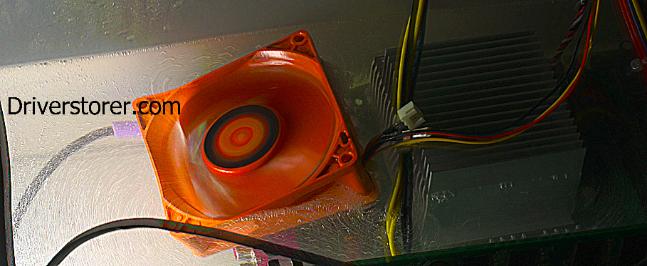
Convection currents in the oil cooled PC are visible in this still, as the bubbles can be seen circulating around the test tub, and eventually getting sucked back into the fan. The orange fan used was an older, massive CFM Thermaltake 80mm turbo fan designed for their older high end heatsinks. We could not submerge this fan all the way, as eventually the fan would fall into a strange stall-start loop pattern. This may be attributed to the dinky Dell 250W powersupply not being able to keep up with the increased current on the +12V line.
On the other hand, the benefits could greatly outweigh the drawbacks in a properly set up oil cooled PC. It has the potential for completely silent computer cooling and many other benefits for workstations and gaming applications.
Our oil cooled PC project was successful, though the Dell fought us at every step. It took 2 or 3 hard drives before the dell decided it could use one, and it wouldn’t even boot unless we plugged in the stock case fan, which on the dell case also acts as the CPU fan; there is no fan directly on the CPU cooler. While on the topic of the stock CPU fan, this CPU fan had its own thermal couple and it was able to control its own speed based on the temperature of the air it was circulating. Because of this, there was no internal hardware monitor on the motherboard for temperatures.
The Dell also couldn’t be overclocked, which cut the experiment short. The device drivers included with the fresh Windows install gave us enough functional room to run some stress tests with SuperPi. At full load the P4 chip didn’t exceed 105 degrees even when the fan was placed in a bad spot in the oil. We moved it back to a more optimal location and the temp dropped to 100. This is with no other cooling, simply the oil acting as a heat capacitor.
We also tested Arctic Silver 5 thermal paste emulsified in mineral oil, and the oil remains non conductive even with a rather large amount of micron size silver particles suspended in it, which is a good sign in case there’s any conductive silver thermal grease in any components that may leach out.
Since our oil cooled PC concept worked well we decided to go ahead with the next stage, in which we will custom build an advanced submersion oil cooled PC, with all the features we’ve come up with, and do a long term stability test using an AMD X64 3.5 ghz system with ATI 4800 graphics. Stay tuned for updates to the DS oil cooled PC projects.